
Unlocking the Health Benefits of Red Light Therapy: Research-Backed Insights
Red light therapy has moved from specialist clinics into masks, caps, panels and flexible full-body devices. That convenience is useful, but it also makes one question essential: which benefits are supported by research, and which claims go beyond the evidence?
The balanced answer is that photobiomodulation is a real field of study, not a single proven treatment for every goal. Results depend on the wavelength, delivered dose, body area, protocol and population studied. A positive trial using one device does not validate every red light product.
What is red light therapy?
Red light therapy, also called photobiomodulation or low-level light therapy, exposes tissue to selected red and near-infrared wavelengths. These devices do not use ultraviolet light and do not work by deliberately damaging the skin. Researchers are investigating how absorbed photons influence mitochondrial activity, nitric-oxide signalling, local circulation and cellular responses to stress.
Mechanisms are still being refined. A widely cited review of photobiomodulation mechanisms describes several plausible pathways while making clear that response varies with dose and biological context.
Photobiomodulation is also different from an infrared sauna blanket. A red light LED device is designed around wavelength, irradiance and energy dose; an infrared heat blanket is designed primarily to raise temperature and create a heat experience.
Where is the evidence most relevant?
Skin appearance and resilience
Red and near-infrared light have been investigated for photoageing, fine lines, elasticity and skin texture. In a controlled study, participants receiving red or near-infrared light showed improvements in several skin measurements compared with controls. Read the controlled skin study.
That does not justify promises to erase wrinkles or reproduce a clinic result with any mask. Study devices, treatment schedules and measurement methods differ. The responsible expectation is gradual support for aspects of skin appearance when a suitable device is used consistently.
For targeted home use, the Forge red light face mask and neck piece holds the LEDs at a repeatable distance. Fit and comfort matter because a theoretically impressive device achieves little if it is difficult to use regularly.
Hair and scalp
Low-level light devices have also been studied in androgenetic hair loss. A systematic review of light-based treatments reports encouraging findings, but studies vary in device design and quality. Light may support follicle activity for some people; it cannot identify or correct every cause of shedding.
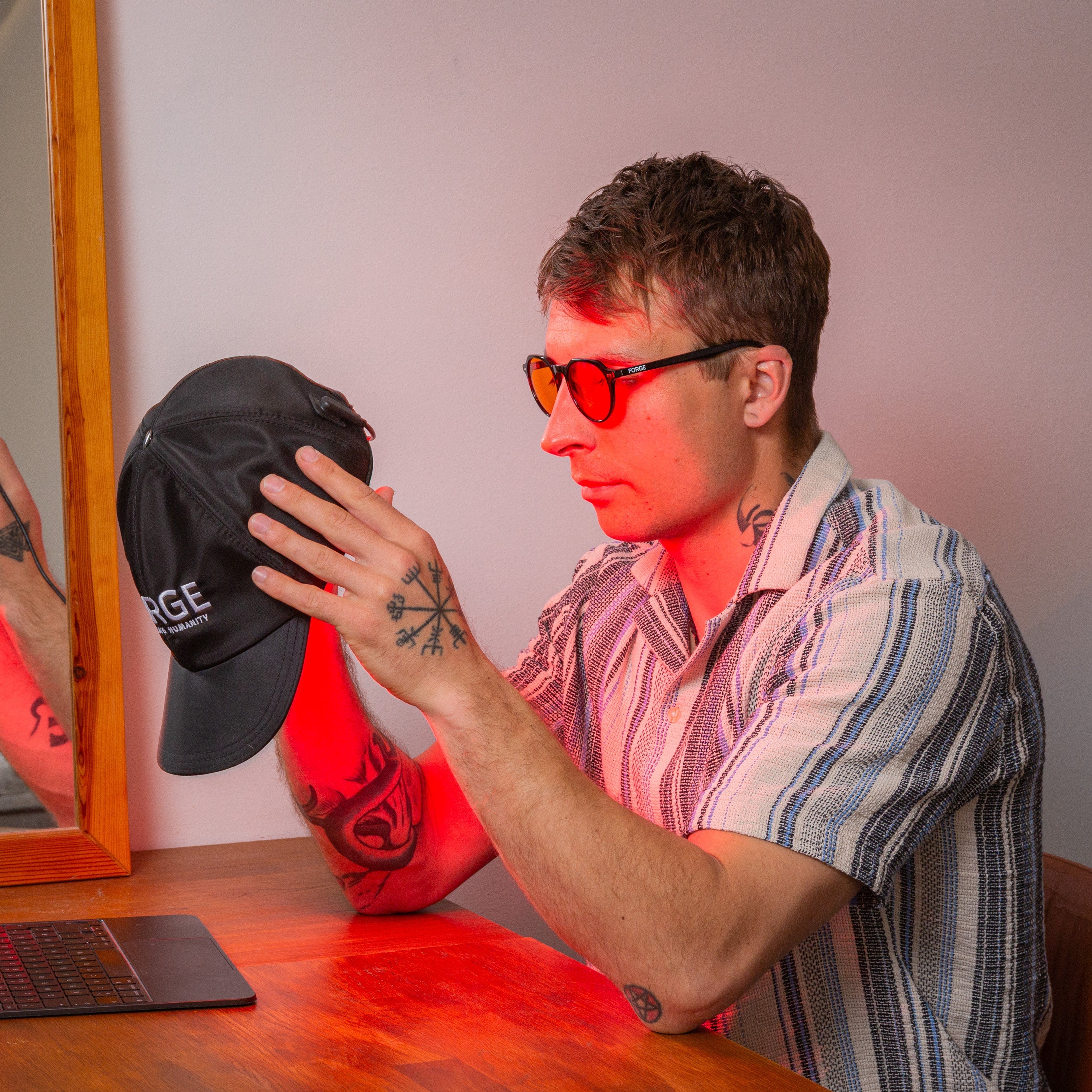
Sudden, patchy or painful hair loss, scalp sores or marked itching should be assessed by a doctor or dermatologist. For a routine aimed at the scalp, the Forge LED red light cap offers close, hands-free coverage, but it should be viewed as an adjunct rather than a diagnosis or guaranteed regrowth solution.
Exercise and recovery
Photobiomodulation around exercise has been studied for performance, fatigue, soreness and markers of muscle damage. Some reviews report favourable results under particular protocols. A meta-analysis of acute exercise studies found potential benefits, while individual controlled trials have also reported no advantage over placebo for selected outcomes.
This mixed picture matters. A full-body red light blanket can make broad exposure practical, but it should not be sold as a replacement for sleep, appropriate training load, nutrition or medical care for an injury.
Pain, inflammation and clinical applications
Photobiomodulation is researched in several clinical contexts, including pain and tissue recovery. Those findings are indication-specific. They do not mean a consumer mask or cap treats inflammatory disease. Clinical protocols may use different power, positioning, supervision and endpoints.
Cognition: promising research, not an established home claim
Transcranial photobiomodulation is an emerging research area. Small studies explore brain function and near-infrared wavelengths, but consumer red light products are not proven to prevent or treat dementia, Alzheimer’s disease or other neurological conditions. The Forge devices that include 1,072 nm use a near-infrared wavelength; this should not be presented as a separate, clinically proven “deep infrared” brain therapy.
Blue light, acne and a common misconception
Blue light has been investigated for effects involving Cutibacterium acnes. Red light is more often discussed as a possible adjunct for inflammatory responses and recovery. It is therefore inaccurate to say that red light automatically kills acne bacteria. Acne can have several causes, and persistent or scarring acne deserves professional advice.
A multicolour mask can provide different options, but more colours do not mean stronger evidence. See the Forge multicolour LED face mask and our separate guide to therapeutic wavelengths.
Dose is the bridge between a wavelength and a result
A useful wavelength is only part of the protocol. Irradiance describes power reaching each square centimetre, usually in mW/cm². Energy dose combines irradiance and exposure time and is commonly expressed in J/cm². Distance, angle, skin contact, hair, fit and coverage all change what reaches tissue.
More is not automatically better. Photobiomodulation can show a biphasic response: an insufficient dose may do little, while extending a session beyond the relevant range may not add benefit. Follow the instructions for the specific device rather than copying the treatment time from an unrelated clinical paper.
How to choose a home device
Start with the body area and routine you will actually maintain:
● Choose a fitted mask for repeatable face and neck exposure.
● Choose a cap when the scalp is the primary target.
● Choose a flexible blanket when broad body coverage and lying down suit your routine.
● Check stated wavelengths, irradiance at a realistic distance, timer, coverage, safety instructions and warranty.
● Be cautious with “medical grade,” total wattage and LED count when no delivered-light measurement is provided.
Browse the Forge red light therapy collection to compare formats. Product specifications can help you choose, but they are not proof of a particular health outcome.
A realistic conclusion
Red light therapy is best understood as a dose-dependent light intervention with promising evidence in selected areas. Skin appearance and some hair and exercise outcomes have meaningful research behind them, while results remain device- and protocol-specific. Cognitive and broad disease claims require much stronger evidence.
Choose a format you can use consistently, follow its protocol, track one relevant outcome and give gradual changes enough time to become visible. Evidence-aware expectations make red light therapy more useful—and far less confusing.
This article provides general information and does not replace medical advice, diagnosis or treatment.
Sources
● Photobiomodulation mechanisms review
● Controlled study of red and near-infrared light for skin

Comments