
Blue Light Glasses: A Complete Guide to Eye Comfort, Better Sleep, and Healthier Screen Use (2026)
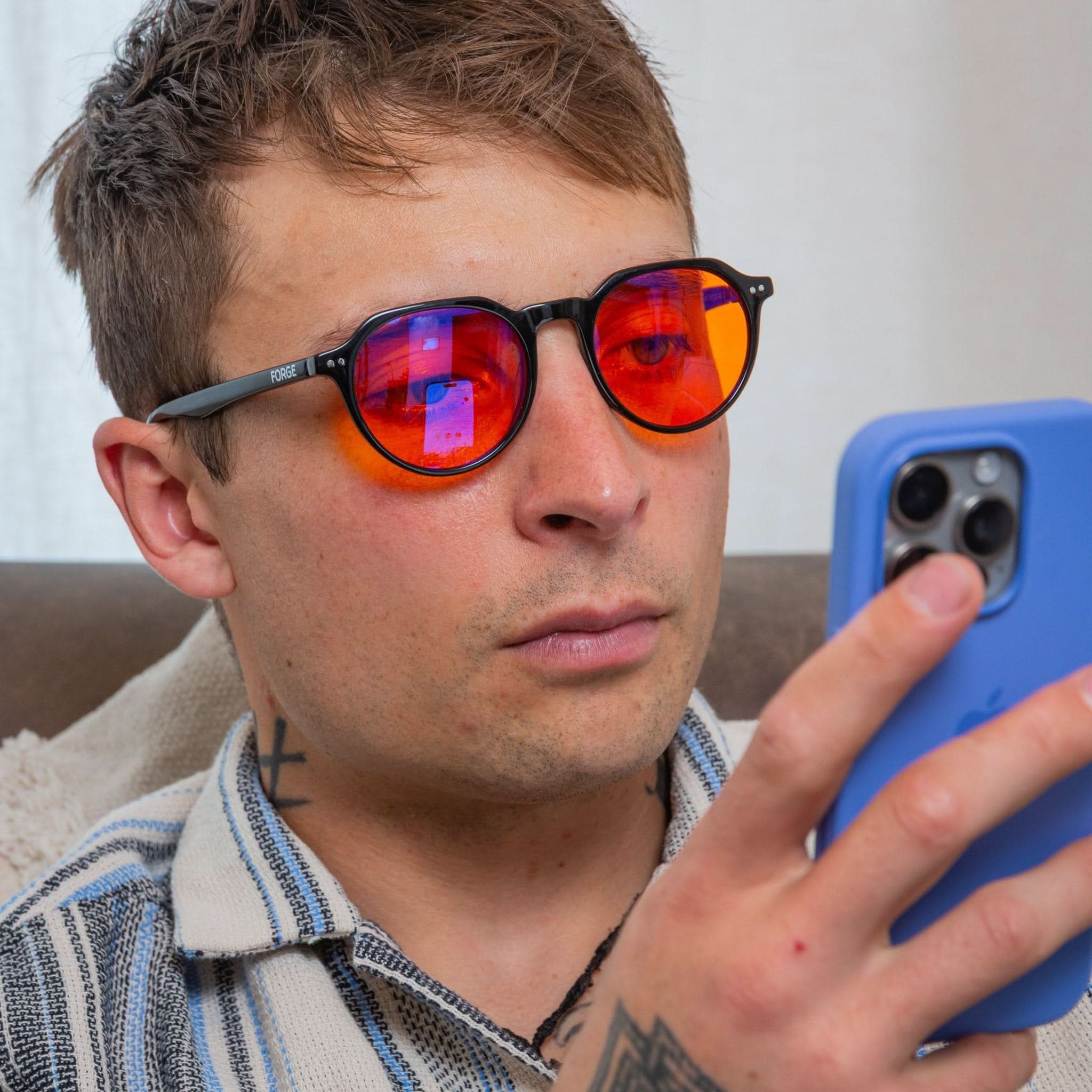
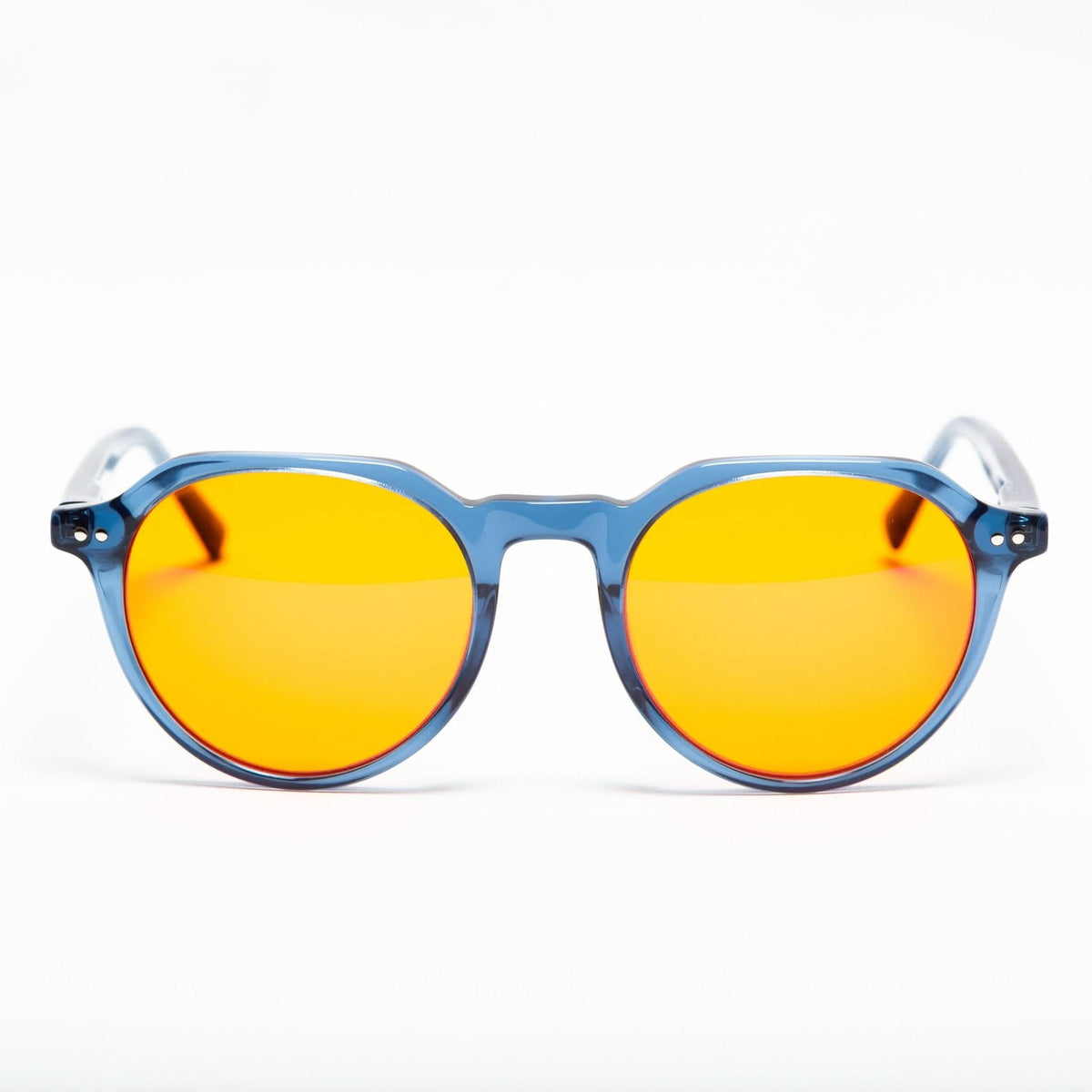
Blue light glasses range from nearly clear daytime lenses to strongly tinted orange filters. They may share a product category, but they do not perform the same job. A light, transparent filter preserves colour perception. A strong orange filter removes far more short-wavelength visible light and noticeably changes the way the world looks.
The useful question is not simply, “Do they block blue light?” Ask how much, across which wavelength range, at what time of day, and with which safety limitations.
This guide explains how to choose and use orange blue light blocking glasses without turning an optical measurement into a medical promise.
What is blue light?
Visible light contains a spectrum of wavelengths. Blue light occupies the shorter-wavelength region, although exact boundaries vary between scientific and commercial definitions. Daylight is by far our largest natural source. Screens, LEDs and other artificial lighting contribute indoors.
Blue light is not inherently bad. Bright daytime light helps signal wakefulness and anchor the circadian system. Problems can arise when the contrast between day and night becomes weak: too little light when we should be alert and too much bright light when we are preparing to sleep.
Specialised cells in the retina send information about environmental light to the body’s clock. Timing, intensity, duration, spectrum and your recent light history all matter. Reducing short-wavelength light in the evening may support a clearer light-dark routine, but glasses do not guarantee faster sleep or more deep sleep.
Does ordinary screen light damage the eyes?
There is no good evidence that normal phone and computer use permanently damages the retina because of blue light. Digital eye strain is nevertheless real. Dryness, blurred vision, headache and tired eyes can reflect reduced blinking, prolonged close focus, glare, posture or an outdated prescription. A 2023 Cochrane review found that blue-filtering lenses may not reduce short-term eye strain compared with non-filtering lenses; evidence for several other outcomes was uncertain.
Some users—including members of the Forge team—nevertheless report that the orange tint makes screens and bright indoor lighting feel markedly more comfortable at night. That is valid personal experience, not a universal treatment claim. Regular breaks, deliberate blinking, sensible screen distance and an eye examination for persistent symptoms still matter.
Clear computer glasses versus orange evening glasses
Clear or lightly yellow lenses may filter a limited part of the spectrum while keeping colours relatively natural. That can suit daytime work, but a generic percentage tells you little unless the manufacturer states the measured wavelength range.
Orange lenses are intended for a different context. They strongly reduce violet-to-blue wavelengths, preserve more yellow and red light, and shift colour perception. This makes them suitable for a controlled evening routine—but unsuitable for activities that require accurate signal recognition.
A full transmission curve is more informative than a laser-pointer demonstration, which samples one narrow and often unspecified wavelength.
What Forge’s lens report shows
The supplier report for Forge Blue Light Blocking Glasses identifies an orange CR-39 sample and reports:
● Tsb (380–500 nm): 2.07% transmission
● therefore 97.93% filtration across the stated 380–500 nm band, or approximately 98%
● roughly 51% luminous transmission under each of the three listed standards
This does not mean 100% of every wavelength commonly called blue is blocked. Nor does it mean the glasses block all visible light. The report’s spectrum rises strongly through green-yellow wavelengths and allows most orange-red light through.
The limitations belong beside the headline number. The report is issued by the eyewear supplier and does not identify an independent accredited laboratory or measurement uncertainty. It marks the tested sample “Road Use And Driving: FAILED” and “Driving In Twilight or Night: NOT SUITABLE.” It also records failures involving blue and green signal-light recognition.
Read the dedicated article, The Real Science Behind Blue Light Blockers, for the spectral point values and a line-by-line explanation.
When should you wear orange blue light glasses?
If your goal is a more sleep-friendly wind-down, start at least one hour before bed. Some people prefer one to two hours. Put them on while screens and household lights are still in use, dim the environment where practical, and keep the glasses on until you switch the lights off.
They can be worn while reading, watching TV, working at a computer or relaxing at home. The lightweight, comfortable unisex frame is designed to make that routine easy to follow rather than feel like a clinical intervention.
You may also wear them on a plane, in an airport, or for a well-lit evening shop visit or dog walk when you are away from traffic. Remove them if steps, obstacles or signals become harder to see.
Never wear these orange lenses while driving at dusk or night. Avoid them while cycling in traffic, operating machinery or performing any safety-critical task where colour and maximum visibility matter.
What happens at lights-out?
The glasses reduce selected wavelengths before bed; they do not create a dark sleeping environment after you take them off. A simple sequence is:
1. Dim overhead lighting and lower unnecessary screen brightness.
2. Put on the orange glasses at least one hour before your intended bedtime.
3. Keep them on while evening lights and screens remain active.
4. Switch off the lights and remove the glasses.
5. Use a Forge Silk Sleep Mask if curtains, a hotel room or travel conditions do not provide enough darkness.
The Forge Sleep Optimisation Bundle combines those two environmental tools. Neither replaces adequate time in bed, a consistent schedule or clinical care for a persistent sleep disorder.
Can they improve sleep?
Research into evening blue-blocking glasses is promising in some settings but mixed overall. A systematic review of evening use found positive findings in several sleep and circadian populations, yet studies differed in lens properties, timing, participants and outcomes. A trial in healthy adults is one useful piece of evidence, not proof that every user will respond.
Treat the glasses as one controllable part of a larger system: seek daylight when you need to be awake, keep evening light calmer, use a dark bedroom and allow enough opportunity for sleep. Our Sleep Optimisation Guide puts those elements in order.
What about travel and jet lag?
Light is a powerful timing signal across time zones. Orange lenses can reduce unwanted light during a planned period, but avoiding light at the wrong time can delay adaptation. They cannot prevent jet lag. Plan around the destination schedule, and remember that the no-driving rule still applies after arrival.
How to choose blue light glasses
Look for five things:
1. Purpose: a subtle daytime filter or a strong evening filter?
2. Defined wavelength range: a percentage without a range is incomplete.
3. Full transmission data: preferably a curve, not just a laser photo.
4. Visible-light and safety disclosure: strong tint has practical trade-offs.
5. Comfortable fit: the best evening filter is useless if you will not wear it.
Be cautious with “100% blue light blocking” unless the seller defines the band and publishes supporting data. Forge’s bounded claim is approximately 98% filtration from 380 to 500 nm for the tested sample—not all blue or visible light.
Bottom line
Orange blue light blocking glasses are a practical way to reduce a measured range of short-wavelength light during the last part of the evening. Forge’s report supports a 97.93% filtration calculation for 380–500 nm and about 51% visible-light transmission, while clearly ruling the sample unsuitable for road use and twilight or night driving.
They may support a consistent wind-down, and some users report less visual discomfort. Evidence for eye strain and sleep remains mixed, so those outcomes should not be guaranteed. Keep daylight, darkness, regularity and enough sleep at the centre.
Sources
● Wenzhou Joysee Eyewear Company Ltd. Sunglasses Certification Report, CR39-D (2019), retained as Forge product documentation.
● Cochrane: Blue-light filtering spectacle lenses for visual performance, macular protection and sleep
● Hester et al.: Evening wear of blue-blocking glasses for sleep and mood disorders
● Bigalke et al.: Effects of blue-light-blocking glasses on sleep in healthy adults
● Chang et al.: Evening use of light-emitting eReaders and circadian timing
This article provides general information and is not medical or optometric advice. Seek professional assessment for persistent eye discomfort, headaches or sleep problems.

Comments