What Really is Light? - and how does it effect us & life on our planet

So What Really is light? - you are about to find out!
Quick note before I get started: am getting a lot questions about “why you cannot see the infra red light when using our red light mask on “IR” mode.2 Some people are confusing this with the device not working - this is not the case. For this reason, I have decided to write a blog explaining light, the wavelengths visible and not visible to the human eye - you guessed right! IR light beyond 700nm is invisible! Also I will briefly explain some interesting facts about how we experience light while out in the world, and how other animals perceive light in different ways! If you missed most of high school like I did, you will definitively learn something interesting in this blog! The cool things is, that these questions have resulted in not only myself but hopefully a lot of other people having a much deeper understanding about light in general - which is such a fundamental part of our existence.
So let’s start from the beginning - Most people look up red light therapy because they want better skin, recovery, or energy. They also look up sauna blankets because they want heat, sweating, and that deep “reset” feeling. Maybe when they find that sauna blankets exist, they have the same revelation I had - “wow, I literally can have my own infrared sauna at home, for a tenth of the price, that gives same effect, yet can be packed away (hence not annoying my fiancé) and used easily in a small Oslo apartment! Woowza!
But here’s the truth: if you don’t understand what light is, the whole conversation around light therapy becomes very confusing fast. The questions we get:
- Why can you see 630 nm red light, but not “IR mode”?
- Is red light meant to be hot on the skin?
- Why can an infrared sauna blanket heat you up when you can’t see any light?
- Why do colours disappear when you scuba dive, even though the sun is still shining? - hehe, we don't get this question but I find it interesting as I love scuba diving.
At the end of the day, it’s all the same thing: physics. And once you get the basics, red light therapy and infrared saunas stops feeling like a wellness trend and starts making clean biological and scientific sense.
Light is electromagnetic radiation — the world runs on wavelengths, solar panels and your own body included!
Light is electromagnetic radiation: energy that travels through space as waves (and packets called photons). The most important thing to understand is:
Wavelength determines what light does.
Wavelength is measured in nanometers (nm).
- Short wavelength = higher energy (UV) - the stuff you need sunscreen for! UV will damage your DNA, accelerating skin aging. Please don’t use tanning beds folks!
- Long wavelength = lower energy (infrared) - the goooooood stuff!
The human eye sees only a narrow slice:
Roughly 380–700 nm is “visible light” for humans.
Everything beyond that still exists. Your eyes just don’t detect it. Here is a diagram showing exactly what wavelengths your evolutionary machinery has the honour of witnessing:

Why humans can’t see infrared (but biology still responds)
Humans are not “built” to perceive most of the spectrum. Past about 700 nm, light becomes near-infrared (NIR) and turns invisible to normal vision. This also applies to UV rays which we cannot see but which still burn us!
So:
- 415 nm (blue) → visible
- 630–633 nm (red) → visible
- 830 nm (NIR) → invisible (so no, your red light mask is not broken)
- 1072 nm (deep NIR) → invisible (you might start feeling subtle heat)
- 2000 nm+ is when things start heating up!
This is why, on a mask that uses red + NIR (e.g., 633 and 830 nm), you might see the red glow clearly but not “see” the infrared component. The device can be emitting strongly; it’s simply outside your visual range.
A fascinating detail: under very specific conditions (very high radiance), humans can sometimes perceive faint light beyond the classic boundaries — but for normal consumer devices, the practical rule holds: NIR is invisible.
Here are the light spectrums you can and cannot see:

Here is a graphic depicting from the invisible UV to visible to invisible infra red light scale:

Other animals live in a different “light reality” (and we built tech to catch up)
Humans are spectrum-limited. Other species aren’t. Evolution has set our light spectrum to the most useful mode for our species survival in our environment. For example, we are great at spotting bright fruits and berries - yum!
- Many insects (like bees) see ultraviolet patterns - so don’t mess with the bees, yo! They are light ninjas, and great at helping us keep the planet green!
- Some animals sense infrared heat signatures
- Some birds perceive additional spectral information
Humans compensate with technology:
- Infrared cameras translate heat into visible images
- Night-vision devices make near-infrared “visible”
- Medical and industrial sensors detect wavelengths we can’t perceive
So if you can’t see something, it doesn’t mean it’s not real — it just means your biology isn’t tuned to that wavelength.
The scuba diving proof: physics decides what you see
If you’ve ever scuba dived (or even snorkelled), you’ve seen this first-hand:
As you go deeper, the world loses colour — reds disappear first, then orange and yellow, and everything becomes blue-green.
This is because water acts like a spectral filter. It absorbs different wavelengths at different rates. Red light (longer wavelength) is absorbed quickly, so at around ~5 meters, red can be mostly gone. This is personally why I most enjoy scuba diving in rock gardens, kelp forest and corral gardens as they are most common at depths 3 - 10m.
That’s why:
- A red object underwater looks grey or dark
- A flashlight “brings colours back” — because it reintroduces missing wavelengths locally
This same principle — selective absorption by a medium — helps explain infrared sauna heat too (more on that below).

Blue light (415 nm): why it can “disinfect” skin
Blue light has a real scientific role in dermatology. Around 415 nm, blue light can affect acne-related bacteria because Cutibacterium acnes produces porphyrins that absorb strongly in the blue range; when excited, these reactions can generate oxidative stress that reduces bacterial load. This is why we sell a light therapy mask that includes blue light, so that people with bacterial skin conditions can use science in a control manner to disinfect their skin. And no, we are not comparing you to a Mola Mola fish - unless you want us to! :)
This is the scientific “blue light disinfects” story — and nature offers a surprisingly memorable parallel.
The ocean sunfish (Mola mola) and “surface light”
Ocean sunfish are known for “basking” near the surface. One hypothesis discussed in the scientific literature is that surfacing relates to parasite management (including potential parasite removal via cleaners), among other reasons. On a side note, if you want to meet a sun fish we can recommend scuba diving in Oman at the dive centre Mola Mola! You might see whale sharks as well!
The broader point holds beautifully:
Light at the surface of the world isn’t only for vision — it influences living tissue and microbial ecosystems.
But timing matters. Blue light is powerful… and it also controls your circadian rhythm.
Check out this humble Mola Mola disinfecting itself using the power of the sun god:

Light and circadian rhythm: the most important “light therapy” is timing
Your brain uses light to set your internal clock. In practice:
- Morning light (especially blue-rich daylight) → wakefulness, alertness, stable rhythm. This is definitely a time you do not want to be wearing your blue light blocking glasses as you actually want the blue light in your eyes to tell your body it is time to rock and roll!
- Evening blue light (screens, bright LEDs) → melatonin suppression, delayed sleep, lighter sleep. This is when you want to wear your blue light blocking glasses so that your eyes block blue light and your body knows it is time to sleep.
This is why blue light blockers can be useful at night: not because blue light is “bad,” but because blue light at the wrong time is biologically confusing.
In places like Oslo—where winter darkness and summer brightness can push sleep schedules around—this becomes even more relevant in real life. Just remember - sleep is either your greatest strength or your greatest weakness. Never compromise on it unless you are getting married: on your bachelor party, your wedding night, and once you have kids. <3

Red light (630–633 nm): visible, surface-biased signalling
Red light around 630–633 nm is visible. It sits near the edge of the human visual range.
In light-therapy contexts, this range is often used for photobiomodulation—a fancy word for “light interacting with biology as a signal.” Many protocols focus on skin and superficial tissue because red light tends to interact more strongly closer to the surface than NIR.
This is why red light is commonly discussed in relation to:
- skin tone and texture
- recovery signaling
- local circulation support
Note: in the picture below you see the human only using the red light devices but the truth is, you can also share the benefits with your dog, cat, mouse, or horse!

Near-infrared (830 nm and beyond): invisible, deeper penetration
Near-infrared light (like 830 nm) is invisible, but it tends to penetrate deeper than visible red light. That’s one reason many devices combine red + NIR: different wavelengths, different depth profiles.
So on an “IR mode” using 633 + 830 nm:
- you see the 633 nm red
- you don’t see the 830 nm NIR
- yet both can be present and active
Some premium devices also include deeper NIR like 1072 nm, again invisible to the eye.
Important safety note: invisible doesn’t mean harmless. With any powerful emitter, especially around the face/eyes, you want to follow eye-safety guidance.
Below you see someone sleeping while using our red light therapy blanket wearing a Forge sleep mask to block out…you called it - light! Wooohooo.

When light becomes heat: the infrared sauna blanket explanation (finally, it makes sense)
Here’s the simplest way to understand infrared heat:
Heat happens when radiation is absorbed.
There isn’t one magical “heat wavelength,” but water absorption becomes a dominant factor beyond roughly the near-infrared region, with strong features around the ~1450 nm area. This is why when using our red light therapy cap which has 1072nm you will start feeling the heat. This heat will only increase the higher you go.
Now jump to far-infrared—the range most sauna blankets and infra sauna rooms operate in:
- ~10,000–15,000 nm (often within a broad FIR band)
At these long wavelengths:
- your eyes cannot see anything
- the energy is readily absorbed by water-containing tissues
- absorbed energy becomes vibrational motion → heat
So yes—an infrared sauna blanket is using infrared light… but far beyond visibility, and the main effect is thermal stress (warming, circulation, sweating, heat adaptation), not “you should see a glow.”

This is the same physics lesson as scuba diving:
- underwater: water selectively absorbs wavelengths → colours disappear
- sauna blanket: water in tissues absorbs FIR → heat appears
Signal vs heat: the single most important distinction
A lot of confusion in “light therapy” comes from mixing two different categories:
1) Red/NIR light therapy (e.g., ~630–850–1072 nm)
- primarily signal-dominant
- aims at cellular and tissue responses without heavy heat load
2) Far-infrared sauna (e.g., ~10,000–15,000 nm)
- heat-dominant
- drives thermoregulation, cardiovascular load, sweating
Both can be valuable, but they are not interchangeable.
How this connects (naturally) to modern tools people use
Once you understand wavelengths, different tools make sense as “spectrum solutions”:
- Blue light filtering at night → supports circadian rhythm and sleep timing
- Red + near-infrared devices (mask, cap, blanket) → targeted or full-body signaling
- Far-infrared sauna blankets → controlled heat exposure and thermal adaptation
At Forge, that’s essentially how we think about the category: light as physics + biology first, products second.
The takeaways people should remember!
You can’t see beyond ~700 nm. So yes, your mask is working in “IR” mode even though you cannot see the light. <3
But your body absolutely responds beyond it.
You can’t see the “IR mode” on a mask at 830 nm.
You can’t see the infrared in a sauna blanket at 10,000–15,000 nm - but I garantee you which feel the heat and start sweating your …… off!
And underwater, you lose red first by ~5 meters because water filters wavelengths.
It’s all the same story:
“Light is not just what you see. Light is how matter behaves. And biology is made of matter.”
That’s the real foundation of red light therapy and infrared heat—whether you’re using them for skin, recovery, sleep rhythm, or heat adaptation
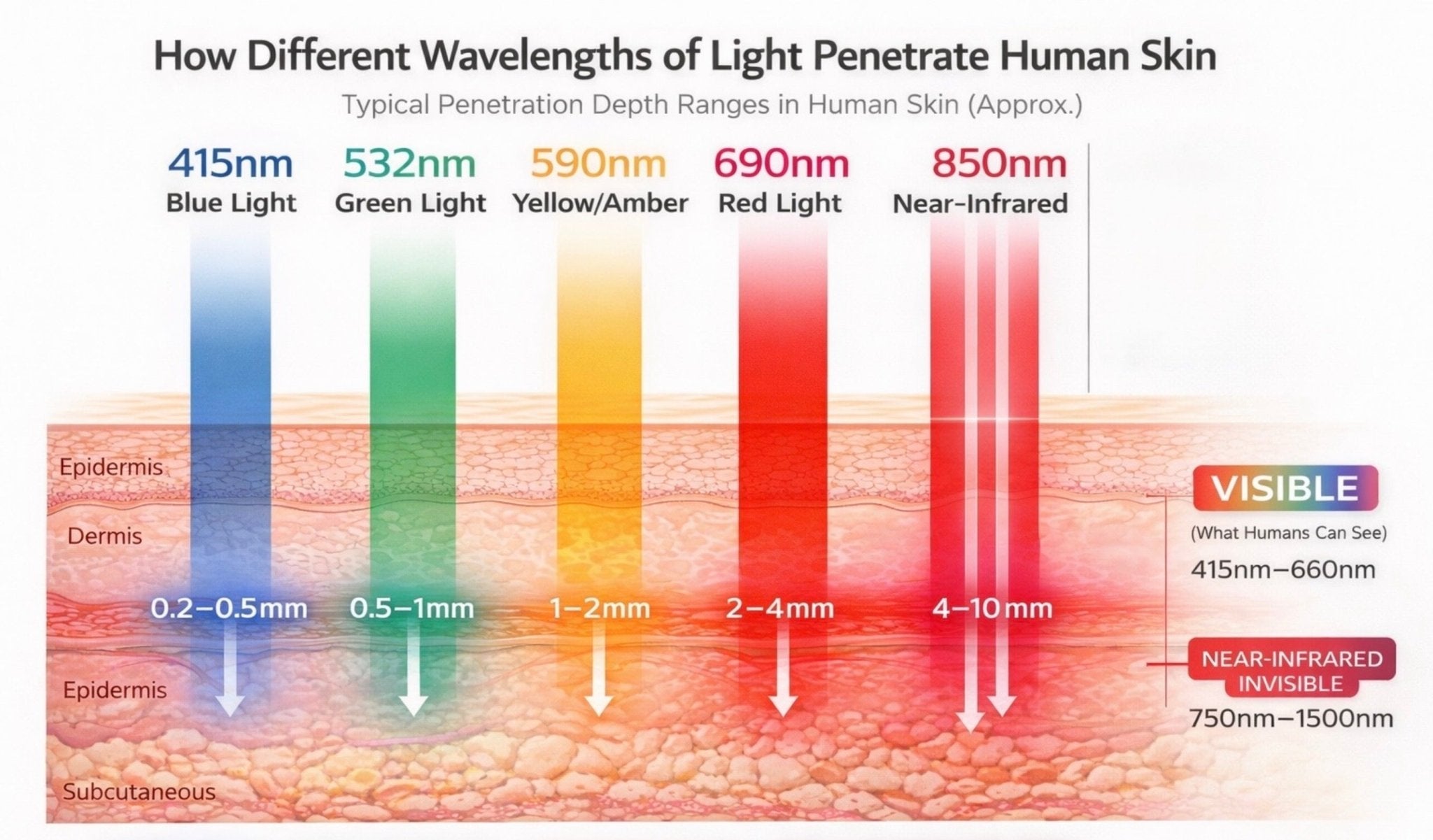
Last diagram I will leave you will is how the different light wave lengths penetrate your skin:

I really really hope that this blog has opened your eyes to the wonderful world of light - a fundamental apart of the universe and our existence. Of course we have not figured out everything there is to know about light but that is the exciting thing about technology, human innovation and the future - we are sure to uncover more beneficial things soon, for instance how light and lasers are being used to combat some of the deadliest disease! And you can count on Forge to stay on the cutting edge.
Forge your future, and stay optimised! :)